Transportation
Boats were the most important mode of transportation. All types of boats, and we used them in
all types of weather.
More than once we ran out of fuel, or broke down, and waited for someone to help us.
Despite the seeming isolation, the waterways were highways,
and there was always some one going back and forth.
Brian's girlfriend Lexy (they later married), Mom and Dad are seen here in our boat. I am standing
on the "wharf", and Gary is at the wheel. The "wharf" was a string of pairs of logs lashed together with
cables and joined to another section with boom chains, to allow us to moor the boat beyond low tide
mark. Brian is taking the picture.
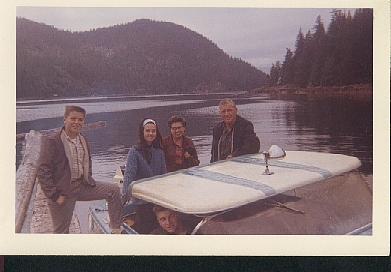
Brian is sawing a log in the foreground. In the background is another view of our boat, with our dog Butch

- Speedboats - along with the one pictured above, we had a smaller one Dad used for
salmon fishing and I used for just running around in.
- Seine Boat
- Gillnetters
- Trollers
- Tugboats
- Scows, a generic name for a flat-bottomed boat used by local people of the First Nations, mainly
Xwemalhkwu, of which the anglocized version is Homalco
- Rowboats
- Sailboats
- Yachts
- Floats - these were rafts of good floating logs, usually fir, with stringers along each end
to tie the whole thing together. Cables looped over and around the stringers and under each
log in the raft. Railway spikes were driven in to crimp the cables tight against the
logs to hold it all together. These were used for transporting yarders, cats, houses, and anything else
larger
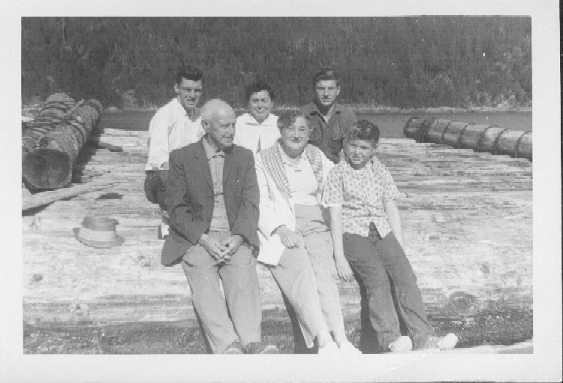
than would fit in a boat. The picture below shows my grandparents and family sitting on our
large float. To move the cat and arch to another "show" ( logging site), Dad would load them
onto the float and hire a tugboat to tow the loaded float. We also had a smaller float we
would load with empty fuel barrels and tow to Tipton's Store and fuel station
to refill the barrels.
- Fuel Barges - Tipton's store, later Hopkin's store was the Esso fuel agent. The Esso barge would top
up the tanks from time to time
- Ferries This arrived
after we left the Island; while we were there we used the BC highways ferry, the Quadra Queen from Quathiasko to Campbell River.
- Coastal Freighters. A freighter by the name of the El Paso came in to Surge Narrows store, to the
the government wharf to drop off mail and freight (boom chains and food)
- Sea Kayaking is popular there
now.
- More sea kayaking, I have
been most places this slide
show goes around Surge, Octupus Islands and The Hole in the Wall.
Airplanes also figured prominently in the daily commercial transportation of the islands.
The aircraft were always on floats, there were no runways on any of the islands.
Healthy loggers, injured loggers, miners, timber cruisers, tourists all routinely travelled by air.
We rarely used them, as it was too expensive, but I did get a couple of flights while I lived on
Read. When we did fly, Island Air, Campbell River was the charter outfit we used.
 DeHaviland Beaver
My favourite aircraft is the Beaver, pictured here. Along with all the Boeing 7x7s, I have
flown in most float-equipped Cessnas, a Grumman Goose operated by Queen Charlotte Air, a few Airbus
variants, the larger DC-Xs, and the original, the DC-3, and a couple of L10-11s. The Beaver is the
best. The Goose and the DC-3 are close seconds. Everything else is fifth.
A Goose is pictured here

home